Michigan State University Athletics
Izzo Describes Life-Changing Experience In Kuwait
5/31/2006 12:00:00 AM | Men's Basketball
May 31, 2006
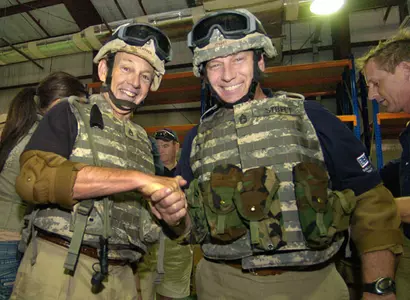
EAST LANSING, Mich. - Michigan State men's basketball coach Tom Izzo addressed the media on Wednesday afternoon following his return from Operation Hardwood II (May 23-29) in Kuwait. Izzo led Camp Patriot in a 12-team basketball tournament on Camp Arifjan. The other teams were coached by Alabama's Mark Gottfried, South Carolina's Dave Odom, Charlotte's Bobby Lutz, Indiana's Kelvin Sampson, Texas' Rick Barnes, U.S. Military Academy's Jim Crews, U.S. Naval Academy's Billy Lange, Kentucky's Tubby Smith, Maryland's Gary Williams, former Air Force coach Reggie Minton from the NABC and ESPN basketball analyst Jay Bilas. Fox Sports broadcaster Leeann Tweeden accompanied the tour participants.
In addition to coaching in the tournament, Izzo and the other coaches had several other unique opportunities, including conducting a youth clinic in Kuwait City, visiting a military hospital, driving a tank, and taking part in a training exercise to escape from an overturned Humvee. All the participants stayed in the barracks on Camp Arifjan.
Q: What are your general thoughts?
A: For me, it was another incredible experience. Unfortunately, last year we were undefeated there and this year we didn't win a game. I had a different team, Camp Patriot. The good news is Kelvin Sampson won it, so the Big Ten is 2-0 in Kuwait.
There were parts that were even better than before. We got to do some more things. The general talked to us the first day and we got a slide presentation on what is going on over there. We got to tour some areas where they show where the troops are going up each day and how many vehicles are going into Iraq.
I thought that was great, and yet the games were really special. I saw players crying after losses. The last day, which was the day before the Memorial Day attacks up in Baghdad where it got even worse, there were four or five teams that were going right from the games up to Baghdad that night. The thought of that and the experience was incredible. Kelvin Sampson had a team member who had died, and the shoes he was supposed to have, they kept on the bench with them. Other teams had similar incidences. Again there were some life-changing, bone-chilling experiences and situations.
The weather was a lot cooler, 110-112. One day it got to 120, but as you remember the year before it was 130-135. We did stay on base this time which I thought was really neat. We'd go to bed at 12 or 1 o'clock and get up at 3:30 to watch the Pistons live. We did that a few times and didn't get much sleep. It was amazing how many soldiers were up working out and watching the games. That was kind of fun to be a part of. I met a lot of people from Wisconsin, Michigan and Ohio on this trip. There was a guy in the naval hospital whose big dream was to take a picture with Kelvin and me because he was a Big Ten guy, so that was fun.
Q: What was your living situation like? Was it a tent situation?
A: No, we were not in tents. We were in barracks. We were in the high society part. Eighty percent of the base stays in tents, so we did get a little better treatment. We had separate rooms with community bathrooms and showers. The nice part was being on the base the whole time we didn't have to travel back and forth, and we'd go from 6-6:30 in the morning until 12 at night just doing things. You had ability to go back and forth to a room or to a spot.
Q: Where were you and how did you hear about the Memorial Day attacks in Baghdad and how did it hit you?
A: We had just landed in Frankfurt, Germany. After the games we had a little cookout banquet with the troops and we left at about 10:30 to go to the airport and we flew out at 1:30 in the morning. We got to Frankfurt and went to a United lounge and it was all over the news that things had gotten worse in Baghdad. It was an eerie feeling. All of a sudden, in the thrill of being there and the excitement of everything, the reality kind of hits hard. Everybody felt bad about that.
It was interesting because we were watching the news and we had done some training in a Humvee. One of the big problems they are having over there is these Humvees tip over a lot because of the weight. They are 10,000 pounds with 250-pound doors. They turn over and flip upside down or sometimes they flip over into these canals. They were losing soldiers who were drowning and not being able to get out of them. So they have a simulator to give you that experience. The fastest that any soldiers have gotten out of that is 12 seconds to get four soldiers out. I think most of the coaches were in there a day, or day and a half. It was amazing the first time you did it. You're upside down. You're disoriented and you have to picture being shot at or being in water. They talk about wearing seatbelts and driving slower, but when you are getting shot at driving through the streets like they show on TV, you can see where these things are going hard. That part made it real because we had just driven the Humvees and gone through the training, then to watch it on TV was just bone-chilling.
Q: Did you get to see any soldiers you saw in the last tournament?
A: Just one. Most of the soldiers are on a 10 month to a year stay and then they go back. There was one guy on Tubby Smith's team that I had coached and he is getting ready to leave next week. It just happens that he had us in August when he first arrived. 99 percent of the people were different.
Q: Can you give us an idea of what it meant to the troops to have you go back over again?
A: Like last year, they were all so appreciative and thankful. One of the different things we did was have what they called a town meeting. The first night we got there they brought all these troops into an auditorium and we just answered questions. Soldier after soldier came up and used the microphone to ask a question. That was interesting with questions like "What would you do if your son or daughter wanted to join the military?" Everybody gave the generic "I'd be proud of them" and then you walk out of there and you think about it and you say "wow, if my daughter asked me that, it would be a hard question to answer." You get a better appreciation of who those people are. I got a chance to meet some people from St. Johns, one from Grand Blanc, one from Grand Ledge, one from Bath, a couple from Lansing and a couple from the U.P. so we exchanged snow stories. It was awesome.
Q: Besides coaching the teams, what other kind of activities did you get to participate in?
A: We went down to Kuwait City and put on a clinic for some kids in town. We did go downtown for one meal there. It was on a Thursday night and Wednesday-Thursday over there is like Friday-Saturday here and it was hopping. For the most part, the people there are very friendly to the Americans. We liberated them so that's all part of it. Other than that it was just working out with them, eating with them and spending time with them. We drove the M1 tanks again. This time we had a chance to drive a Humvee and other military vehicles. That took up most of our time besides watching the NBA Playoffs at 4 in the morning.
Q: Is this going to be an annual thing?
A: I think they are going to try and keep it going. I think we will be done with it because I think everybody agreed that everybody should have more of an opportunity to go there. The only thing I didn't get to participate in is we were supposed to go on an aircraft carrier, but that got pushed back and I was not able to do that.
The group we were with was great. Rick Barnes from Texas was a great addition, as were Tubby Smith (Kentucky) and Gary Williams (Maryland). It was fun to watch the new guys. We also had the head coach of the Naval Academy and the head coach of the Army, Jim Crews, who was at Indiana for a long time, so about half the guys were new. We also had Reggie Minton, who used to be the head coach at Air Force and whose son is in the military. It was interesting to watch those guys and how they handled it. Again, it was an experience I wouldn't trade for a million bucks. I think I got every bit as much out of it as I did last year.
Q: How many games did you play?
A: We played five. Some teams played as many as seven. It was pool play this time because there were 12 teams. It was a little bit more diluted because a couple of the bases, like my base, was divided into two teams. I had the new team with guys that had just come in.
Q: Have you ever been 0-5?
A: I've never been 0-5, but it was a good 0-5.
Q: Would we be amazed at when you coaches are together how little basketball you talk?
A: We did talk a little basketball, but it was a lot about the troops and a lot about our teams and even a lot about the NBA. If we talked basketball, it was not Xs and Os, but what are we going to do to better our game, what are going to do to keep things more positive. But when we were there, I think 80 percent of the conversation was about what we were witnessing and what goes on. There would always be that lunch when you saw someone coming back or that dinner when you sat with someone going up (to Iraq) that night. I had an assistant coach that had been in Baghdad when they first started fighting and he talked about being in a Humvee for 5 months and showering with a can of water and a couple of wipes. It made me realize that this is DisneyWorld, where we were (in Kuwait) is tough, but not even close to what it's like up there (in Iraq). And yet to a person, they said we are making progress and they got their shot in to say the media always paints such a negative picture and they are tired of it.
Q: Do you have more lessons that you took from this one that you'll share with your team?
A: I think what this trip did is it refreshed what I felt last year. I think like everything in life, time heals. I think it was good for me to get another dose of reality and get perspective back a little bit. I've said it before, I've had a lot of great people to look up to, but the true heroes are the people over there. There's no question about it because of what they do on a daily basis and what they have a chance to give up. Life is a little different than what we have a chance to give up here.
Q: Was Kelvin Sampson's team stacked?
A: No, Tubby had my team, but it wasn't as good as the one I had. Kelvin had a good team. Jay Bilas had a good team this year, as did Dave Odom. Those were the final four.
Q: Were there ever times off base when you felt unsafe?
A: Going down to Kuwait City, first of all you felt unsafe on the highway. They say that is a problem. It's almost like the Autobahn. The night when we went down there to eat, it was a little different. You saw hotels where you used to be able to drive up to the door that are barricaded now. And when you go in those places, it's three rounds of metal detectors. That part was different, but I didn't feel unsafe.